Alexandra Schmitz · Art de l’Anglage · Les Brenets

A method shaped in the workshop.

Since 2006, Alexandra Schmitz has developed a demanding finishing eye, and then a way of teaching that is clear, precise and consistent.

Jewellery, watch decoration, inspection, training, workshop responsibility: this journey is not here to decorate a CV. It explains where her way of seeing comes from, what she corrects first, and the standard she aims to make last.

“I look first at the line, the width and the reflection. Correction comes afterwards.”

A journey that matters

Each step changed something in the way she teaches.

The point is not to unfold a biography. It is to understand where the eye, the rigour and the teaching framework offered today come from.

01 Jewellery foundation

The material is already teaching the eye.

At MATY and then in a jewellery workshop, Alexandra works on creation, stone setting, repairs, soldering, ring sizing and polishing. Before watchmaking, there is already a relationship to the material, to the trace left by the tool and to surface condition.

In training, this comes through in the attention paid to the support, the pressure and the surface condition.

Year
2005
Places
  • MATY Jeweller
  • Jewellery workshop
What takes root
  • Respect for the material
  • Reading surfaces
  • Precision of gesture
Jewellery Jewellery making Polishing
02 Entering the workshop

The gesture enters the workshop.

At Compagnie Horlogère Locloise SA, anglage and watch decoration become part of everyday work. The gesture is then measured against pace, consistency and inspection. This still matters in the way she teaches: one isolated success is not enough, it has to be repeatable cleanly.

The standard starts to show in consistency, not in effect.

Period
2006–2009
Places
  • Laser Automation
  • Compagnie Horlogère Locloise SA
What grows stronger
  • Workshop rigour
  • Consistency of gesture
  • Sense of responsibility
Workshop Rigour Responsibility
03 Consolidation

The eye becomes sharper.

Decotech, JBH and then José Lopes refine the eye: varied finishes, inspection, teaching new collaborators. Correction becomes more precise: where the deviation lies, why it appears, and how to take it back without blurring the rest.

The more precise the eye becomes, the less correction needs long explanations.

Period
2009–2019
Stages
  • Decotech
  • JBH
  • José Lopes
What becomes clearer
  • Stricter reading
  • More targeted correction
  • Bench-to-bench transmission
Finishing Inspection Teaching
04 Entrepreneurial chapter

Structuring things differently.

Between 2019 and 2021, Alexandra co-managed two electronic cigarette shops in Guadeloupe and took part in developing a product range. Far from the watchmaking bench, this step still reinforced three useful things for today: structure, the clarity of an offer, and attention to the client’s real need.

Its value is not on the part itself. It shows in the way a serious, clear and sustainable framework is built.

Period
2019–2021
Activity
  • Co-managing two shops in Guadeloupe
  • Product range development
  • Daily operations and client relations
What it brings
  • Entrepreneurial mindset
  • A broader view of an activity
  • Attention to the final client’s real need
Entrepreneurship Co-management Guadeloupe
05 Practice + teaching

The part and teaching come together.

At Inhotec and then Swissmec, the part and teaching come together. This is where the method truly becomes clear: demonstrate, make them observe, make them do it again, correct without delay. Learning no longer floats around the gesture; it rests on real work, its defects, its corrections and the standard expected.

You do not learn anglage in the abstract. You learn it from what the work reveals.

Period
2021–2025
Places
  • Inhotec
  • Swissmec
  • Art de l’Anglage founded in 2025
What becomes clear
  • Real practice on actual parts
  • Immediate correction
  • Teaching tied to the result achieved
Part Training Founded 2025
06 Current framework

Giving the method its own framework.

With Art de l’Anglage, Alexandra gives this method its own framework: small groups, real attention to each piece of work, closely followed progress, and a clear level of rigour. The journey is no longer a series of steps. It becomes a stable framework for learning seriously.

This project does not promise an atmosphere. It promises a level of reading, correction and rigour.

Today
Art de l’Anglage
Art de l’Anglage today
  • Les Brenets
  • Small groups
  • Enthusiasts, professionals, companies
What it makes possible
  • Teach without dilution
  • Follow progress closely
  • Maintain a clear standard
Les Brenets Teaching Small groups
What this journey shaped

What my years in the workshop changed in the way I teach.

Over time, the training became simpler in form and more demanding in substance: observe more accurately, correct more clearly, and connect each gesture to a real standard.

01

Observe before correcting.

When a line drifts or a reflection breaks, correction begins with accurate observation. It avoids vague instructions and mechanical gestures.

02

Name the deviation precisely.

Correction is not about starting everything again when the issue comes from pressure, angle or width. It has to be exact, otherwise it exhausts without helping progress.

03

Connect the gesture to real quality.

A finish does not live on its own. It must be even, defensible and compatible with the standard expected all the way to the final client.

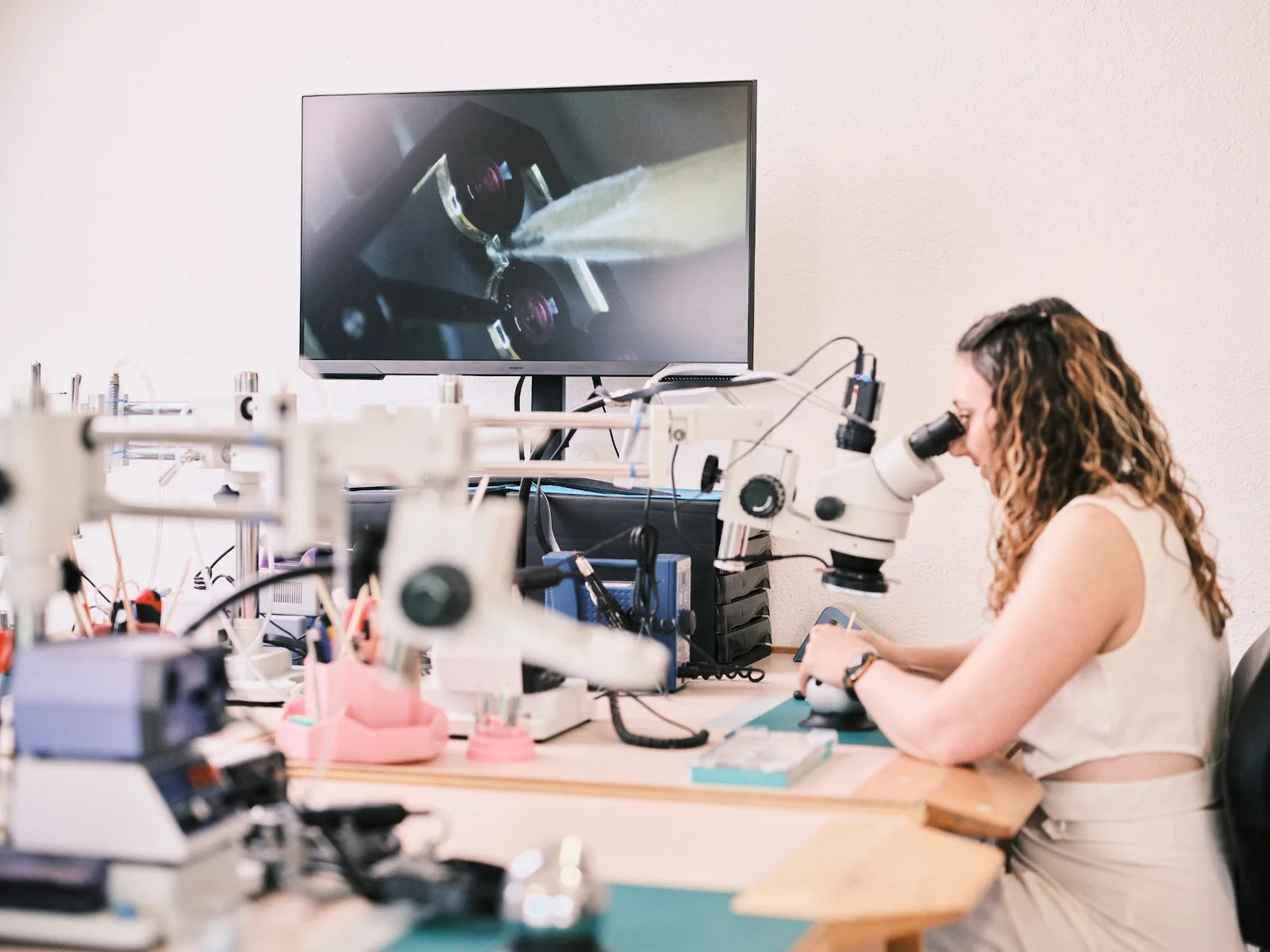
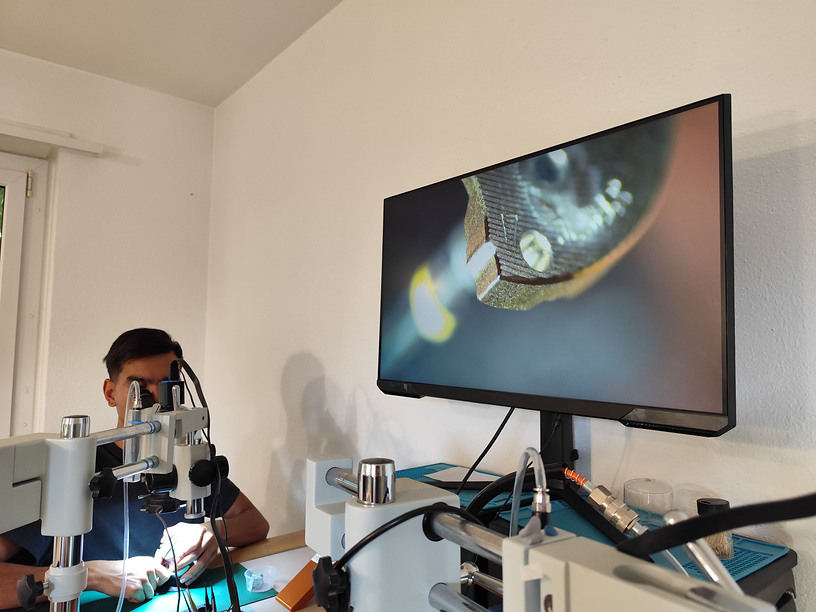
Art de l’Anglage workshop in Les Brenets
Why Les Brenets

A place aligned with the work, the light and the watchmaking roots.

Les Brenets is not a backdrop. The workshop belongs to a real watchmaking area, close to Le Locle and its history, in a region where precision, gesture and watch culture still have concrete roots.

This place also matters in Alexandra’s journey. Teaching here today gives the project a coherence that cannot be manufactured.

It also brings something very concrete to daily work: calm, concentration and useful light for reading a reflection, following a line and correcting cleanly. Here, the place truly serves the gesture.

A real watchmaking region.

The workshop remains rooted in a territory consistent with watchmaking, its standards and its history.

Real grounding.

This choice extends a journey already tied to this region. It gives the project a simple and credible base.

Useful light and quiet.

The conditions of the place help one observe more finely, read the work better and correct with greater accuracy.

Teaching principles

What guides the training, in concrete terms.

These principles are short because they need to stay operational. They are there to help progress more cleanly, with a standard one can genuinely stand behind.

They also say what I refuse: no theatrical pressure, no posturing, no vague tolerance on the part.

“When I observe a part, I look first at the line, the width and the reflection. When I correct a gesture, I look for the exact deviation before asking someone to start again.”

Principles that hold.

Simple principles, applied on the part.

  • See before going fast. The right pace comes after accurate observation.
  • Name the deviation exactly. A vague instruction produces a vague gesture.
  • Correct straight away. Do not let a defect settle through repetition.
  • Make the gesture reliable. Getting it right once is not enough.
  • Connect the gesture to real quality. The result remains the final judge.

What I refuse in training.

  • Unnecessary pressure that blocks the eye.
  • Authority posturing that crushes instead of clarifies.
  • Shortcuts that create the illusion of a standard.
  • Tolerated approximation on the part.
  • Letting someone repeat for too long without clear correction.

Rigour does not need theatre. It needs precision, calm and honesty about the result.

Natural next step

You now know where this method comes from.

The Training page helps you choose the framework that best fits your level and your objective. Bookings then give you the next available dates.